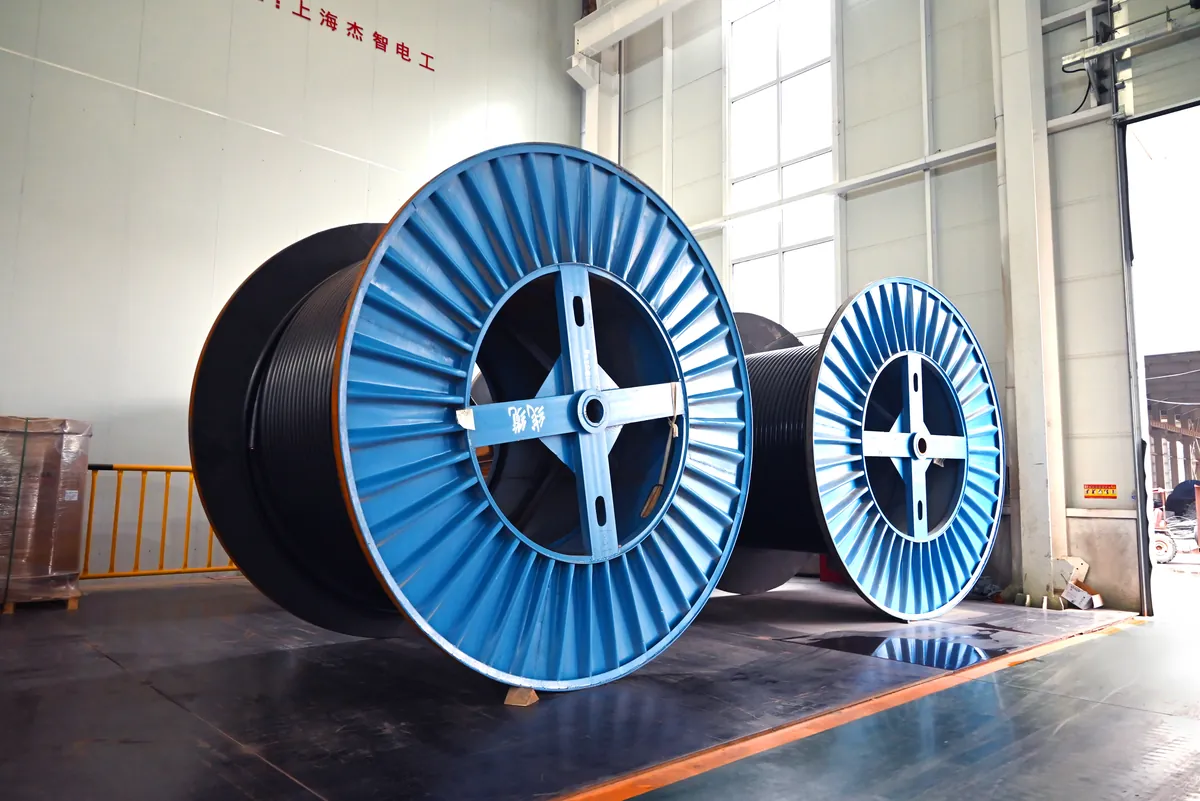
A cable that passes its factory test can still fail in the field within eighteen months. In almost every case we are asked to investigate, the cable was not defective — it was specified against the wrong parameter. The conductor size was calculated for current but not for voltage drop, or the insulation was rated for ambient temperature but not for the conductor temperature it would actually reach under load.
This article walks through the four parameters that decide whether a power cable reaches its rated service life, and the specific failure mode that follows when each one is set wrong.
Conductor cross-section: current is the easy half
Ampacity tables give a current-carrying capacity for a given cross-section under stated reference conditions — usually 30 °C ambient, a single circuit, free air or a defined installation method. Those conditions almost never match the installation.
Derating is where the margin disappears
Three derating factors apply in series, and they multiply rather than add: ambient temperature, grouping, and installation method. A 95 mm² cable rated at 250 A in free air can drop below 160 A when it is one of six circuits on a tray at 45 °C. Sizing from the table figure alone leaves the conductor running continuously above its rated temperature, which accelerates thermal ageing of the insulation.
Voltage drop usually governs long runs
On runs beyond roughly 100 metres, voltage drop rather than ampacity typically sets the size. Most installation standards allow 3–5 % total drop. A conductor sized purely on current will often exceed that, and the symptom appears at the load end — motors drawing higher current to compensate, which in turn heats the cable further.
Insulation compound: match the conductor temperature, not the room
The three common compounds behave very differently once loaded:
- PVC — 70 °C conductor rating. Low cost, good chemical resistance, but softens under sustained heat and emits dense smoke and halogen acid gas in fire.
- XLPE — 90 °C conductor rating, 250 °C short-circuit. Cross-linked, so it does not soften on overload; carries roughly 20 % more current than PVC at the same cross-section.
- EPR / rubber — 90 °C with far greater flexibility, which is why it is used for trailing, reeling and drag-chain applications where XLPE would work-harden and crack.
The specification error we see most often is selecting PVC for a 90 °C-rated termination, then loading the circuit to the XLPE ampacity figure. The insulation deforms at the gland, contact pressure drops, and the joint becomes a hot spot.
Voltage rating: U0/U is not a single number
A cable marked 0.6/1 kV states two values. U0 (0.6 kV) is the rated voltage between conductor and earth; U (1 kV) is between phase conductors. In an unearthed or impedance-earthed system a phase-to-earth fault raises the healthy phases to full line voltage against earth, and the cable must hold that condition for the duration the protection allows.
Where systems are not solidly earthed, the U0 value — not the nominal system voltage — is the figure to check.
Construction standard: what the buyer is actually specifying
IEC, UL, BS, AS/NZS and VDE are not interchangeable labels for the same cable. They prescribe different conductor classes, different insulation thicknesses for the same voltage, and different test regimes.
The practical consequence at the border
A cable built to IEC 60502-1 and one built to UL 44 can share a cross-section and voltage rating and still have different overall diameters — which changes gland selection, conduit fill and tray loading. More importantly, a customs authority or project inspector checks the certificate against the standard named in the purchase specification. A CE mark does not substitute for a UL listing, and a test report from an unaccredited laboratory does not substitute for either.
How to make the specification auditable
A cable specification that survives an inspection states, at minimum: conductor cross-section and class, insulation compound and rated conductor temperature, U0/U rating, construction standard, and the installation conditions the sizing assumed. That last item is the one most often omitted, and it is the one that makes the calculation reproducible by a third party.
Every cable we manufacture is supplied with a test report from our German-standard independent testing laboratory, with 100 % factory outgoing inspection against the construction standard named on the order. If you are preparing a specification and want the sizing assumptions checked before it goes out to tender, our engineering team reviews them as part of the quotation process.